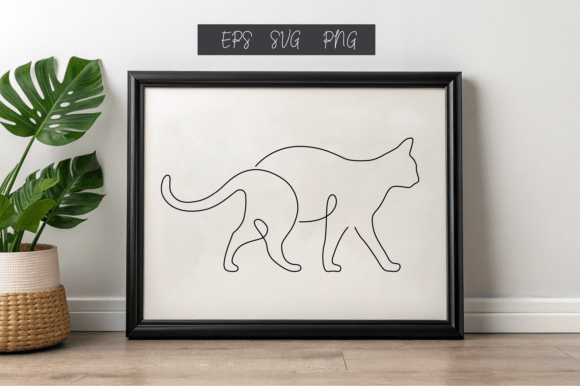
Review: Graceful Walking Cat in One Line Art
As a designer who spends more time staring at stitch maps than actual cats, I am always skeptical of "one-line" concepts when they cross over from digital illustration to physical machine embroidery design. There is a distinct difference between a vector path that looks clean on a screen and a thread path that holds up under the tension of a needle piercing fabric. When I first opened the files for Graceful Walking Cat in One Line Art, my initial reaction was one of cautious optimism. The silhouette is undeniably chic, capturing that specific mid-stride elegance that cat lovers adore. However, the real test for any embroidery file intended for commercial or serious hobbyist use is not how it looks in a preview window, but how it behaves in the hoop.
The Aesthetic Appeal and Design Personality
The mood of this piece is immediate: it is minimalist, modern, and effortlessly cool. In the world of Illustrations and Graphics, continuous line art has been trending for years, but translating that fluidity into thread requires a keen eye for detail. The design avoids the clutter often found in complex pet portraits, opting instead for a single, unbroken flow that suggests form rather than defining every whisker. This makes it incredibly versatile. It feels less like a novelty item and more like a boutique branding element. For an Etsy seller looking to elevate their shop's aesthetic, this kind of subtlety is gold. It speaks to a customer base that values understated elegance over loud, colorful graphics.
Visually, the layout is balanced. The cat's tail and the arch of its back create a natural rhythm that guides the eye. For a handmade product creator, this means the design works well as a focal point without overwhelming the garment. Whether you are aiming for a personalized gift for a feline-obsessed friend or creating a cohesive line of custom apparel, the visual personality here is professional. It doesn't scream "craft project"; it whispers "designer label."
Real-World Application: The Tote Bag Test
To truly evaluate this design, I imagined a specific real-life scenario: producing a run of canvas tote bags for a local coffee shop that wants to sell merchandise with a subtle nod to their resident shop cat. This is a common request for small shop product lines. The Graceful Walking Cat in One Line Art fits this brief perfectly. On a neutral canvas or a heavy cotton twill, the continuous line would stand out beautifully, especially if stitched in a contrasting thread color like charcoal grey on cream, or a deep navy on white.
In this context, the design serves as excellent boutique branding. It is recognizable enough to become a logo but artistic enough to be worn or carried without feeling like an advertisement. For apparel decorators, this translates to high perceived value. A customer is more likely to pay a premium for a tote bag featuring a refined line-art cat than one with a generic, clip-art style image. The simplicity allows the quality of the stitching and the texture of the fabric to shine, which is crucial for building customer trust and ensuring repeat business.
Versatility Across Products
Beyond tote bags, this design shines in several other areas. It is an ideal candidate for sweatshirt embroidery, where large fill areas can sometimes feel too heavy or stiff. A linear design keeps the fabric drape intact, making it comfortable to wear. It also works wonderfully for baby embroidery on onesies or bibs, provided the scale is adjusted correctly. The gentle curves are soft and appealing for nursery decor, such as pillow covers or wall hangings. Even for holiday embroidery projects, like ornament tags or gift toppers, the simplicity allows for quick production without sacrificing style. As a digital embroidery file, its adaptability is its strongest asset.
Technical Considerations and Fabric Challenges
However, we must address the technical realities. Continuous line designs can be tricky depending on the substrate. If you are working with textured fabrics like Terry cloth or thick fleece, a single running stitch might get lost in the pile. In these cases, you might need to adjust the stitch density or consider a slightly thicker thread weight to ensure visibility. Conversely, on very thin fabric or stretchy knits, there is a risk of puckering if the tension isn't managed perfectly. Since this is a line art piece, it likely relies heavily on running stitches or a fine satin stitch. Without a dense fill to anchor it, the design relies on proper stabilization.
For curved surfaces like caps, this design could be stunning on the front panel, but care must be taken with the hoop size and placement to avoid distortion. The "walking" motion of the cat needs to look grounded, not warped by the curve of the hat. Additionally, if you are planning to use this on dark fabric, remember that a single line might need to be double-stitched or outlined to pop against the background. Always test your thread colors against the material; a black thread on a black hoodie might look sophisticated in theory but invisible in practice.
Critical Designer Notes for Success
Before committing to a full production run, there are several steps every craft business owner should take. First, test the design on scrap fabric that matches your final product exactly. This is non-negotiable. Check how the corners turn; in one-line art, sharp turns can sometimes cause thread breaks or bird nests if the machine speed is too high. Second, review stitch density. If the file provided is purely a vector (SVG/EPS) that you are digitizing yourself, ensure your software creates a smooth path. If it is a pre-digitized file, inspect the stitch count and direction.
You should also confirm hoop size requirements. While line art is often small, ensure your hoop accommodates the full stride of the cat without cropping. It is wise to inspect small details like the tip of the tail or the ears, as these are common failure points in linear designs. Furthermore, test it in black and white mockups to see if the contrast holds up without color reliance. Finally, always use proper stabilizer. For a design with so much open space, a cut-away stabilizer might provide better long-term durability than a tear-away, especially for items that will be frequently washing.
Commercial Viability and Licensing
From a business perspective, Graceful Walking Cat in One Line Art has strong potential for commercial embroidery projects. Its clean look appeals to a broad demographic, from young adults to pet owners of all ages. It enhances brand consistency if used across multiple product types, from aprons to patches. However, a crucial reminder for all creative entrepreneurs: always confirm licensing before selling finished items or digital products. The product description mentions editable EPS, SVG, and PNG files suitable for vinyl and printing, but embroidery licensing can vary. Ensure you have the right to use this as a design asset for physical goods you intend to sell.
In conclusion, this design is a thoughtful addition to any library of embroidery project resources. It bridges the gap between digital trendiness and tactile craftsmanship. With the right fabric choice, careful stabilization, and attention to stitch quality, the finished product can be a standout item in any collection. It proves that sometimes, less really is more, provided that "less" is executed with precision and care.