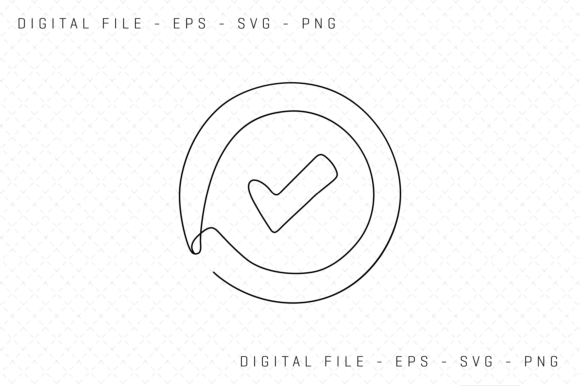
One Line Drawing of a Check Mark: A Designer's Review
As a designer who spends more time staring at stitch simulations than I do sleeping, I approach every new machine embroidery design with a healthy dose of skepticism. We have all been burned by files that look crisp on the screen but turn into a bird's nest of thread on the fabric. So, when I pulled up the One Line Drawing of a Check Mark, my first instinct wasn't to click "buy" immediately, but to analyze its potential for real-world application. This isn't just about having a symbol; it is about understanding how a single continuous line translates into physical texture and durability.
The first impression of this piece is its striking minimalism. In a world where Illustrations often lean toward the overly complex or densely filled, there is a quiet confidence in a design that relies on a single stroke. The mood it creates is modern, clean, and universally positive. A check mark is the ultimate symbol of completion, approval, and success. Visually, the layout is open and airy, which suggests it will breathe well on fabric without weighing it down. For those of us creating handmade products, this visual personality fits perfectly into the current trend of understated branding and subtle personalization.
Real-World Application: The Custom Tote Bag Test
To truly evaluate an embroidery file, you have to imagine it leaving the digital realm. Let's say I am preparing a batch of custom canvas tote bags for a local boutique opening. The client wants something that says "quality checked" or simply adds a chic, graphic element to the side seam. This is where the One Line Drawing of a Check Mark shines. Because the design is essentially a linear path, it behaves very much like a sophisticated running stitch or a narrow satin stitch, depending on how the digitizer handled the width.
On a sturdy cotton canvas, this design would lay flat and crisp. Unlike a heavy fill stitch area that might cause the fabric to pucker or the bag to warp over time, a single-line approach maintains the drape of the material. If I were stitching this onto a sweatshirt embroidery project, perhaps on the cuff or near the hem of a hoodie, the simplicity ensures it doesn't get lost in the fleece texture. It becomes a subtle nod to quality rather than a loud statement. For Etsy sellers looking to create personalized gifts, this versatility is gold. You can easily scale it for a baby onesie or enlarge it for a decorative pillow cover without losing the integrity of the shape.
Navigating Fabric Textures and Challenges
However, practical design judgment requires us to look at where things might go wrong. While the One Line Drawing of a Check Mark is versatile, it demands respect regarding fabric texture and stitch density. If you are working with a highly textured fabric like a waffle knit or a loose-weave linen, a single thin line might get swallowed by the weave. In these cases, you need to be strategic about your thread colors. A high-contrast thread is essential here; if the thread blends too much with the background, the definition of the check mark vanishes.
Another critical consideration is the hoop size and placement. Since this is a linear design, it is generally forgiving, but if you are attempting to place it on a curved surface like a cap, you must ensure the digitizing accounts for the push and pull of the curve. A straight line on a flat screen can bow awkwardly on a structured hat if the underlay isn't sufficient. Furthermore, for items that will undergo frequent washing, such as kitchen towels or baby clothes, the start and end points of the line are vulnerable. You must ensure the file includes proper locking stitches, or you risk the entire design unraveling after a few cycles. Always test on scrap fabric first to verify that the stabilizer you are using provides enough support for the specific weight of your thread and fabric combination.
Commercial Value and Brand Consistency
From a business perspective, incorporating this design into your craft business inventory can significantly enhance perceived value. In the realm of commercial embroidery, clients are paying for professionalism. A sloppy, pixelated, or poorly stitched logo destroys trust. Conversely, a clean, sharp check mark implies precision. It tells the customer that the finished product has been inspected and approved. This psychological cue is powerful for small shop products and boutique branding.
When creating printable mockups or digital previews for your online store, this Graphics asset offers excellent flexibility. Because it is a vector-based concept (often derived from the SVG or EPS files included in the package), it scales infinitely for marketing materials without losing quality. Whether you are designing a hang tag, a social media post, or a website banner, the consistency of the image helps build brand recognition. For digital product sellers, offering this as part of a larger bundle of minimalist icons could be a smart move, provided the licensing terms allow for such redistribution.
Final Verdict and Designer Notes
Before you commit to a full production run, here are my top recommendations for working with the One Line Drawing of a Check Mark:
- Check the File Formats: Ensure the ZIP folder contains the specific machine format you need. The description mentions EPS, SVG, and PNG, which are great for printing and vinyl, but verify if a dedicated embroidery file (like PES, DST, or XXX) is included or if you need to digitize it yourself from the vector sources.
- Contrast is Key: Test the design in both black and white mockups. On dark fabrics, use a metallic or bright thread to make the single line pop. On light fabrics, a deep navy or charcoal can offer a sophisticated look.
- Stabilizer Selection: Even for simple lines, do not skip the stabilizer. A cut-away stabilizer is often safer for stretchy fabrics like t-shirts to prevent distortion over time.
- Licensing Clarity: Always confirm the license before selling finished items. Some designers allow commercial use of the physical product but restrict the sale of the digital file itself.
- Detail Inspection: Zoom in on the corners of the check mark. Sharp turns in a single line can sometimes cause thread bunching if the speed is too high or the tension is off.
In conclusion, the One Line Drawing of a Check Mark is a robust, adaptable asset for the modern maker. It bridges the gap between digital Illustrations and tactile embroidered patch aesthetics. When handled with care regarding fabric choice and stabilization, it elevates custom apparel and home decor with a touch of professional polish. It is a reminder that sometimes, the simplest designs carry the most weight in the marketplace.