Elephant Face Line Art: A Designer's Review
As a designer who spends more time staring at stitch maps than most people care to admit, I approach new Illustrations and Graphics with a healthy dose of skepticism. We have all downloaded a "perfect" file only to find it turns into a bird's nest on the machine. So, when I pulled up the Elephant Face Line Art Illustration, my first instinct wasn't to imagine it on a mockup, but to zoom in until my pixels blurred. I wanted to see how those lines would translate from vector paths to actual thread.
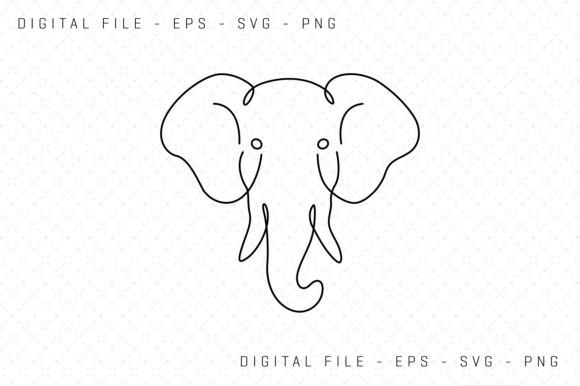
The initial impression is one of gentle minimalism. This isn't a hyper-realistic portrait trying to compete with a photograph; it is a stylized, clean representation that relies on negative space and confident curves. For an embroidery project, this is often where the magic happens. Complex shading can look muddy on textured fabrics, but a strong line art design like this tends to hold its own. The mood it creates is calm and organic, making it an ideal candidate for projects that need to feel handmade and thoughtful rather than mass-produced.
Putting It to the Test: The Tote Bag Scenario
To truly evaluate the Elephant Face Line Art Illustration, I imagined a specific real-life scenario: a custom order for a local boutique selling eco-friendly baby gifts. The client wanted a series of tote bags and muslin swaddle blankets featuring woodland creatures. This is a high-stakes environment for a designer because the fabric choices—canvas for the bags and loose-weave cotton for the swaddles—are notoriously tricky.
On the canvas tote, the design shines. The weight of the fabric supports the structure of the lines, preventing the dreaded "puckering" that can ruin a finished product. If this were converted into an embroidery file using primarily running stitches or a light satin stitch border, the result would be crisp and modern. It fits the current trend of "less is more" in custom apparel and accessories. Customers today often prefer subtle branding over loud, dense logos, and this illustration delivers that understated elegance.
However, moving this design to the muslin swaddle requires caution. Muslin is thin and stretchy. A standard machine embroidery design might pull too hard on such delicate material. Here, the simplicity of the Elephant Face Line Art Illustration becomes a double-edged sword. While there isn't heavy fill to weigh down the fabric, the continuity of the lines means any tension issue will be immediately visible. In this context, I would recommend treating it almost like an applique design outline or using a very lightweight stabilizer to ensure the fabric doesn't distort during stitching.
Versatility Across Products and Markets
Beyond the tote bag test, this graphic has legs in various sectors of the craft business. For an Etsy seller looking to expand their catalog beyond digital downloads, this image is a goldmine for physical goods. Imagine it stitched onto a left-chest pocket of a denim jacket or centered on a linen apron. The linear nature of the art works exceptionally well on curved surfaces, provided the digitizer maintains appropriate pull compensation.
For those creating personalized gifts, such as nursery decor or holiday ornaments, the design offers a neutral palette that adapts to any color scheme. You aren't locked into specific skin tones or realistic colors; the elephant can be stitched in sage green, dusty rose, or classic navy. This flexibility increases the perceived value of the handmade product because it feels bespoke to the buyer's nursery theme.
I also see potential for embroidered patches. Line art translates beautifully to merrowed edge patches. The clean outlines of the elephant face would create a distinct shape that stands out even from a distance, making it excellent for brand recognition if used as a logo for a small shop product. Furthermore, for digital product sellers, this serves as a fantastic base for printable mockups. Because the lines are clear, they render well in promotional images, helping to drive engagement before the physical item is even made.
Technical Considerations and Fabric Choices
While the aesthetic appeal is high, we must discuss the technical execution. Not every fabric is a friend to line art. On highly textured fabrics like chunky knits or terry cloth, thin running stitches can get lost in the pile. If you are planning a sweatshirt embroidery project, you might need to increase the stroke width slightly or opt for a satin stitch to ensure visibility.
Dark fabrics present another challenge. Since this is a line drawing, contrast is king. Stitching a dark thread on a dark garment will render the Elephant Face Line Art Illustration invisible. You must plan your thread colors carefully, perhaps opting for a metallic or a high-contrast matte finish to make the lines pop. Additionally, when working on stretchy fabrics like jersey for baby embroidery, the direction of the stitches matters. Long horizontal lines across a stretchy grain can cause the fabric to ripple after washing. A professional digitizer would account for this by adjusting the stitch angle or suggesting a cut-away stabilizer.
Small hoop sizes are generally safe with this design due to its likely compact nature, but always check the dimensions before committing. If the design includes tiny details in the eyes or trunk wrinkles, these could become problematic on a cap or a small pouch where the curvature distorts the view. Simplifying the inner details might be necessary for smaller applications.
Designer Notes for Commercial Success
Before you list this as a commercial embroidery asset or start fulfilling orders, there are practical steps you must take. First, never skip the test stitch. Run the design on a scrap piece of the exact fabric you intend to use. Check the stitch density; if it looks too sparse, it might snag during laundering. If it's too dense, it could make the fabric stiff and uncomfortable, which is a dealbreaker for wearables.
Secondly, verify the file formats included in your download. The product description mentions editable EPS, SVG, and PNG files. These are excellent for vinyl cutting and printing, but remember that they are not native embroidery files (like PES, DST, or EXP). You will need to digitize these Graphics yourself or hire a digitizer to convert them into a digital embroidery file compatible with your machine. Do not assume the SVG will stitch perfectly without adjustment; screen vectors and thread paths behave differently.
Finally, consider the licensing. If you are an Etsy seller or running a boutique, confirm whether the license allows for unlimited physical sales or if there are caps on production. Using a design outside of its licensed terms can lead to serious issues for your small shop product line. Once cleared, this Elephant Face Line Art Illustration offers a wonderful blend of artistic charm and practical utility, ready to elevate your next creative venture.