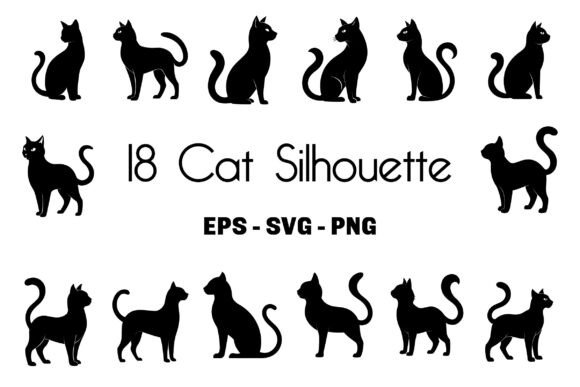
Cat Silhouette Clip Art: A Designer's Review for Embroidery
As a designer who spends more time staring at stitch maps than most people care to admit, I approach new Illustrations and Graphics with a healthy dose of skepticism. We have all been there: you download a file that looks crisp on the screen, only to find it turns into a bird's nest of thread once it hits the fabric. That is why I took a close look at the Cat Silhouette Clip Art set before committing it to any client projects. This isn't just about whether the image is cute; it is about whether it can survive the rigors of a commercial embroidery project and still look professional in the finished product.
My first impression of the Cat Silhouette Clip Art was its simplicity. In the world of machine embroidery, simple is often synonymous with successful. The design relies on clean lines and solid shapes rather than intricate shading or tiny, fragile details. This creates a modern, minimalist mood that fits perfectly with current trends in boutique apparel. When I loaded the SVG file into my digitizing software to inspect the potential pathing, the silhouette held up well. The curves were smooth, suggesting that if properly digitized, this could translate beautifully into a satin stitch border or a solid fill stitch block. For those of us creating custom apparel, this kind of visual clarity is gold.
Putting the Design to the Test: A Real-World Scenario
To truly evaluate this asset, I imagined a specific real-life scenario that many of us face during the holiday rush. Picture a small shop owner needing to produce a batch of twenty matching tote bags for a local cat rescue fundraiser. The goal is a handmade product that looks high-end but can be produced quickly. The Cat Silhouette Clip Art shines here. Because it is a silhouette, it does not require complex color changes or excessive trimming, which speeds up production time significantly.
I visualized stitching this onto a heavy canvas tote bag design. The bold black shape of the cat would pop against a natural or cream-colored fabric, creating a striking contrast. Unlike detailed portraits that might get lost in the texture of canvas, a silhouette remains readable from a distance. This makes it an excellent choice for Etsy seller listings where the main photo needs to grab attention immediately. Furthermore, because the design is essentially a single shape, it works wonderfully as an embroidered patch that could be sewn onto denim jackets or backpacks later. The versatility allows a craft business to use one design asset across multiple product lines, from sweatshirt embroidery to kitchen linens.
Fabric Considerations and Stitching Challenges
However, no design is without its challenges, and a professional review must address where caution is needed. While the Cat Silhouette Clip Art is robust, its application depends heavily on the substrate. If you are working with stretchy fabrics like jersey knits for baby embroidery or athletic wear, the density of the fill becomes critical. A solid silhouette can act like a non-stretch island on a stretchy sea, causing the fabric to pucker around the edges if the stitch density is too high or if the wrong stabilizer is used.
For textured fabrics, such as wool blends or terry cloth towels, the clean edges of a silhouette can sometimes get lost. In these cases, I would recommend adding a slight running stitch outline or a tatami underlay to define the shape further before the main fill kicks in. Additionally, if you are planning to use this on dark fabric, remember that the provided files are likely vector-based outlines or transparent PNGs. You will need to ensure your thread colors provide enough contrast. A black cat on a navy blue sweatshirt might look sophisticated in theory but muddy in reality. Always test your thread color combinations on scrap fabric first.
Another area requiring attention is curved surfaces, such as caps. Placing a wide silhouette on the front panel of a structured cap can be tricky. The hoop size might limit how large you can go, and the curvature can distort the perception of the cat's posture. For hats, I suggest scaling the design down and ensuring the digitization accounts for the push-pull effect of the fabric moving under the needle.
Commercial Viability and Brand Consistency
From a business perspective, the Cat Silhouette Clip Art offers strong potential for brand consistency. Because the style is generic yet distinct, it can be adapted for various niches without losing its identity. Whether you are making holiday embroidery gifts for cat lovers or creating a uniform logo for a pet sitting service, the design maintains a level of professionalism that builds customer trust. Buyers engage more with products that look clean and intentional. A messy or poorly scaled design signals low quality, whereas a crisp silhouette suggests a thoughtful small shop product.
When creating printable mockup images for your online store, this type of graphic is incredibly forgiving. It scales up and down without losing resolution, provided you are using the included SVG or EPS files. The PNG file mentioned in the package, noted as 300 dpi with a transparent background, is suitable for digital previews and marketing materials, ensuring your Etsy listings look sharp. However, for the actual stitching, always revert to the vector formats to allow your embroidery software to generate the most accurate stitch map possible.
Final Verdict and Practical Notes
In conclusion, the Cat Silhouette Clip Art is a reliable tool for the modern embroiderer. It bridges the gap between artistic flair and production efficiency. It is particularly well-suited for commercial embroidery jobs where turnaround time matters, as well as for personalized gift items where the recipient appreciates a sleek aesthetic.
Before you start stitching, keep these practical notes in mind:
- Check the License: The product description mentions it is an illustration set, but always verify the specific licensing terms regarding commercial use before selling finished items or digital derivatives.
- Digitize with Care: If the package does not include a pre-digitized embroidery file (DST, PES, etc.), you will need to digitize the SVG yourself. Pay close attention to corner sharpness and underlay settings.
- Test on Scraps: Never run a full batch without testing on the exact fabric you intend to use. Check for puckering and registration issues.
- Stabilizer Selection: Match your stabilizer to the fabric weight. Heavy cut-away for knits, tear-away for stable wovens.
- Contrast Check: View your design in black and white mockups to ensure the shape reads clearly regardless of color choices.
Ultimately, this design earns a spot in my library for its adaptability and clean visual language. It proves that sometimes, less really is more, especially when that "less" translates into a flawless finished product that customers love to wear and display.